








At first glance, traditional pin-and-sleeve connectors seem like a cost-effective way to power industrial equipment. They’re widely available, meet basic standards like UL 1682, and look simple enough.
But beneath that initial price tag lie ongoing expenses that most facilities don’t calculate—expenses that cut into uptime, energy efficiency, and safety margins every single year.
When you compare real-world operating costs, the “low-cost” pin-and-sleeve option quickly becomes the expensive choice.
The “Low-Cost” Illusion of Pin-and-Sleeve Connectors
Why the initial price doesn’t tell the full story
A typical pin-and-sleeve device might save a few hundred dollars upfront compared to a switch-rated alternative. But that savings vanishes the first time a connection overheats, a contact welds, or a plug must be replaced after repeated wear. Each repair requires downtime, maintenance labor, and often the presence of a qualified electrician—all of which cost far more than the equipment itself.
Hidden downtime and safety expenses
Pin-and-sleeve connectors can’t safely make or break under load. That means each disconnection requires a separate disconnect switch or interlock to comply with NEC 430.102–430.109.
When these systems fail or are installed incorrectly, they expose workers to live parts and arc-flash hazards—risks that translate directly into OSHA citations, injury costs, and insurance liability.
The Real Engineering Problems Behind Pin-and-Sleeve Designs
Contact wear, heat buildup, and poor conductivity
Traditional pin-and-sleeve connectors rely on sliding contacts made from brass, a soft and easily machined metal with poor conductivity and minimal arc resistance. Over time, repeated insertion and removal wear away the contact surface, reducing pressure and increasing resistance. The result: higher temperatures, energy loss, and premature failure.
Laboratory testing shows that MELTRIC’s silver-nickel contacts maintain low resistance even after thousands of operations, while brass contacts rapidly oxidize—causing voltage drops and overheating. What looks like a minor design choice can end up costing thousands in wasted energy and unplanned maintenance.
Arc flash and operator exposure risks
Pin-and-sleeve devices expose live parts during disconnection, creating the potential for dangerous arcs. Even when “de-energized,” users can contact energized metal pins. By contrast, MELTRIC’s switch-rated DECONTACTOR™ technology isolates arcs within enclosed arc chambers and uses a dead-front safety shutter to ensure the user never touches a live part.
This built-in safety eliminates the need for cumbersome PPE and arc-flash permits during normal equipment changeouts, helping maintenance teams simplify NFPA 70E compliance.
What the Standards Don’t Require (But Your Operation Still Pays For)
Limited UL testing vs. switch-rated endurance requirements
Pin-and-sleeve connectors are certified to UL 1682, which only tests for basic temperature rise and mechanical strength—not for load-breaking, short-circuit performance, or arc containment. MELTRIC’s Switch-Rated devices meet the more rigorous UL 2682 standards used for manual motor controllers and enclosed disconnect switches.
That means they’re tested to 6,000 load-breaking operations, 100 kA short-circuit withstand, and overload tests up to 600% of full-load amperage—performance levels no pin-and-sleeve connector can match.
Added cost of auxiliary disconnects and interlocks
To meet NEC and OSHA safety requirements, pin-and-sleeve systems require additional mechanical interlocks or non-fused disconnect switches. These devices increase installation cost and take up valuable space. MELTRIC’s switch-rated design eliminates those add-ons entirely—its integrated switch mechanism allows safe disconnection under full load, acting as its own line-of-sight disconnect.
The result is simpler compliance, lower capital expense, and faster maintenance cycles.
MELTRIC Switch-Rated Devices: A True Cost-of-Ownership Upgrade
Silver-nickel contacts and spring-loaded design
MELTRIC’s contacts are made of 85% silver and 15% nickel, combining exceptional conductivity with arc resistance and hardness. The spring-loaded, butt-style configuration ensures constant contact force—eliminating the gradual loosening and hot spots typical of pin-and-sleeve devices.
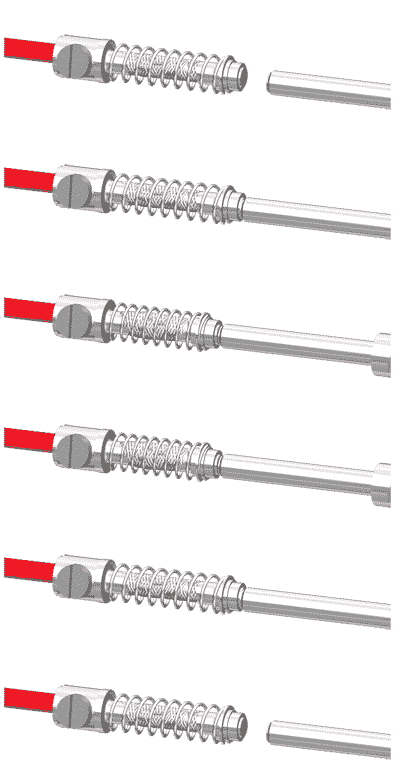
This results in a consistent, low-resistance connection that performs safely over thousands of operations. Learn more about the engineering behind MELTRIC contact design.
Integrated switch, dead-front safety, and arc-free operation
Each MELTRIC Switch-Rated plug and receptacle is a UL and CSA-approved disconnect switch, capable of safely making and breaking motor or branch circuits up to 200 A or 100 hp. The dead-front shutter closes before the plug can be removed, while the spring-loaded mechanism breaks the circuit in just 15 milliseconds—too fast for an external arc to form.
Measurable energy efficiency and longer service life
Independent testing has shown MELTRIC devices to be up to 30 times more energy-efficient over 10 years than equivalent pin-and-sleeve connectors due to lower heat generation and higher contact integrity.
The energy savings, combined with reduced maintenance and downtime, can add up to thousands of dollars per device over its lifespan.
The Bottom Line: Safety and Savings Are Built In
What pin-and-sleeve suppliers don’t tell you is that their products are built to meet the bare minimum—not to protect your people, your equipment, or your budget. MELTRIC’s Switch-Rated plugs and receptacles combine the safety of a switch, the performance of industrial-grade materials, and the simplicity of plug-and-play operation.
When you factor in energy efficiency, compliance, and uptime, the total cost of ownership is no comparison.
Stop paying for hidden costs.
Switch to MELTRIC Switch-Rated plugs and receptacles—engineered for safety, reliability, and performance.
Contact MELTRIC Today →